What is my care home business worth? | Instant valuation | James Dixey
How much Is my care home worth?
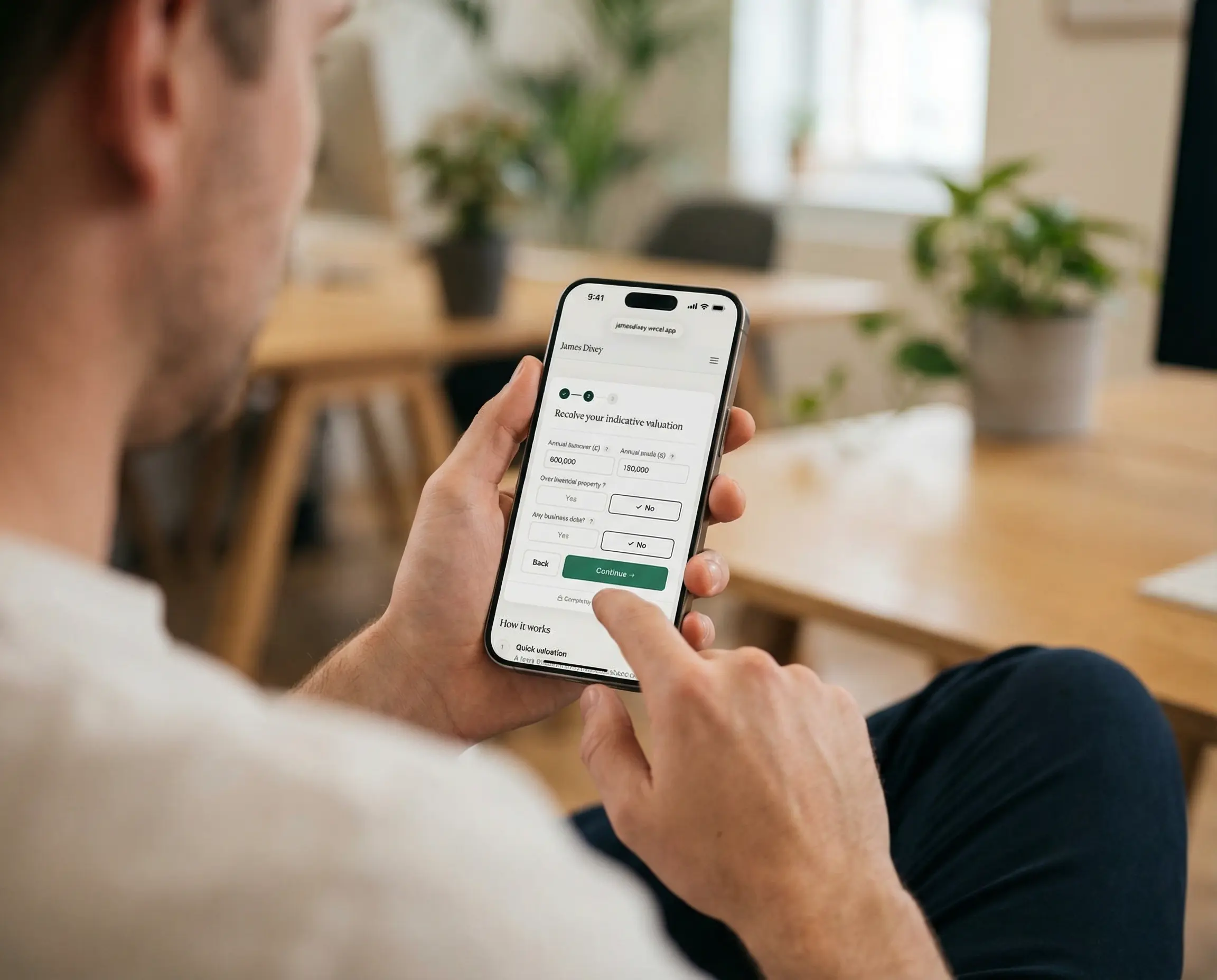
Get a free, indicative valuation based on real market data. No documents needed — it takes around 60 seconds.
Updated October 2026Completely confidential
Step 1 of 3
Get your valuation
Select
United Kingdom
Select region
Completely confidential
Trusted by owners across regulated sectors
Trusted by business owners
Find out how much your business is worth
01
A few quick questions
Everything we ask, you already know. No documents or financials needed. Takes around 60 seconds.
02
Get your indicative range
See what businesses like yours are selling for, based on up-to-date valuation multiples in your sector.
Indicative valuation range
£3.4m – £3.8m
£2.5m£5m
Speak with a specialist
03
Talk to a sector specialist
Speak with an advisor who understands your market, can give you a more accurate valuation, and help you find the right buyer when you're ready.
How are care homes typically valued?
Care home valuations are slightly more complex than many other business types because they combine two elements: the trading business itself and, in most cases, a significant property asset. The business is usually valued on a multiple of adjusted earnings (EBITDA), while the property may be assessed separately depending on whether it's freehold or leasehold. For freehold care homes, the property value and the business value are often intertwined, particularly where the building has been purpose-built or significantly adapted for care use.
What multiples do care homes sell for in the UK?
Multiples for UK care homes typically range from 4x to 9x adjusted earnings, with significant variation depending on size, occupancy, location, and care category. Smaller single-home operations generally sit at the lower end, while larger homes or small groups with strong occupancy and a good mix of private and funded residents can command higher figures. When we speak with buyers, they're increasingly focused on homes that can demonstrate a sustainable fee mix — an over-reliance on local authority-funded placements at low fee rates will typically compress your multiple.
What factors affect the value of a care home?
A number of factors will influence what buyers are willing to pay, and some carry more weight than others.
CQC rating. This is non-negotiable for most serious buyers. A "Good" rating is the expected baseline, and an "Outstanding" rating can add meaningful value. Conversely, a "Requires Improvement" or "Inadequate" rating will significantly reduce your pool of buyers and the price they'll offer.
Occupancy rate. Sustained occupancy above 85–90% signals strong local demand and effective management. Buyers will want to understand your occupancy trend over the past two to three years, not just a snapshot.
Want a more accurate picture?
An online calculator is a useful starting point. Speak with our team to understand what your care home could realistically achieve.
Property condition and capacity. The physical condition of the building matters enormously. Homes that meet or exceed current regulatory standards — room sizes, en-suite provision, communal spaces — are far more attractive than those facing significant capital expenditure. Unused capacity or planning consent for extension can also add value.
Fee rates and payer mix. A healthy proportion of private-pay or NHS-funded residents, as opposed to local authority placements alone, generally supports a stronger valuation. Buyers look closely at average weekly fee rates relative to the local market.
Registered manager and staff. One of the most common concerns we hear from prospective buyers is whether the registered manager and senior care staff will stay on after a sale. A stable, well-led team that isn't dependent on the owner significantly de-risks the acquisition.
Specialisation. Homes registered for nursing care, dementia, or specialist categories such as mental health or learning disabilities often attract higher multiples than standard residential care, reflecting both the higher fee rates and the barriers to entry.
Does it matter whether my care home is freehold or leasehold?
It matters a great deal. Freehold care homes are generally more attractive to buyers because they offer long-term security and the option to leverage the property for financing. Leasehold homes can still command strong valuations, but buyers will scrutinise the remaining lease term, rent review mechanisms, and any restrictions on use or assignment. A short or uncertain lease will materially affect what someone is willing to pay.
Is there demand for care homes right now?
Buyer demand for UK care homes remains strong, driven by long-term demographic trends and a structural undersupply of quality beds in many regions. The number of people aged 85 and over is projected to grow significantly over the coming decades, and new care home development has not kept pace. That said, the sector is not without challenges. Rising operating costs, workforce pressures, and local authority fee negotiations all affect profitability. The strongest demand is for well-run homes with modern facilities, good ratings, and a balanced fee structure.
How long does it take to sell a care home?
From initial valuation to completion, most care home sales take between 6 and 12 months. The regulatory requirements - including CQC registration transfers and, where applicable, local authority contract novations - add time compared to unregulated businesses. Where property is involved, conveyancing and any due diligence on building condition can also extend the timeline. Having up-to-date CQC documentation, clean financial records, and a clear picture of your staffing and occupancy position helps keep things moving.
How accurate is an online care home valuation?
An online valuation gives you a useful starting point based on current market multiples and real transaction data. It can't account for everything — the condition of your building, the specifics of your CQC report, or the dynamics of your local market all play a role that requires closer examination. If the range looks interesting, a confidential conversation about the detail behind your numbers will give you a much more precise picture.